Raphael’s The School of Athens: A High Renaissance Masterpiece
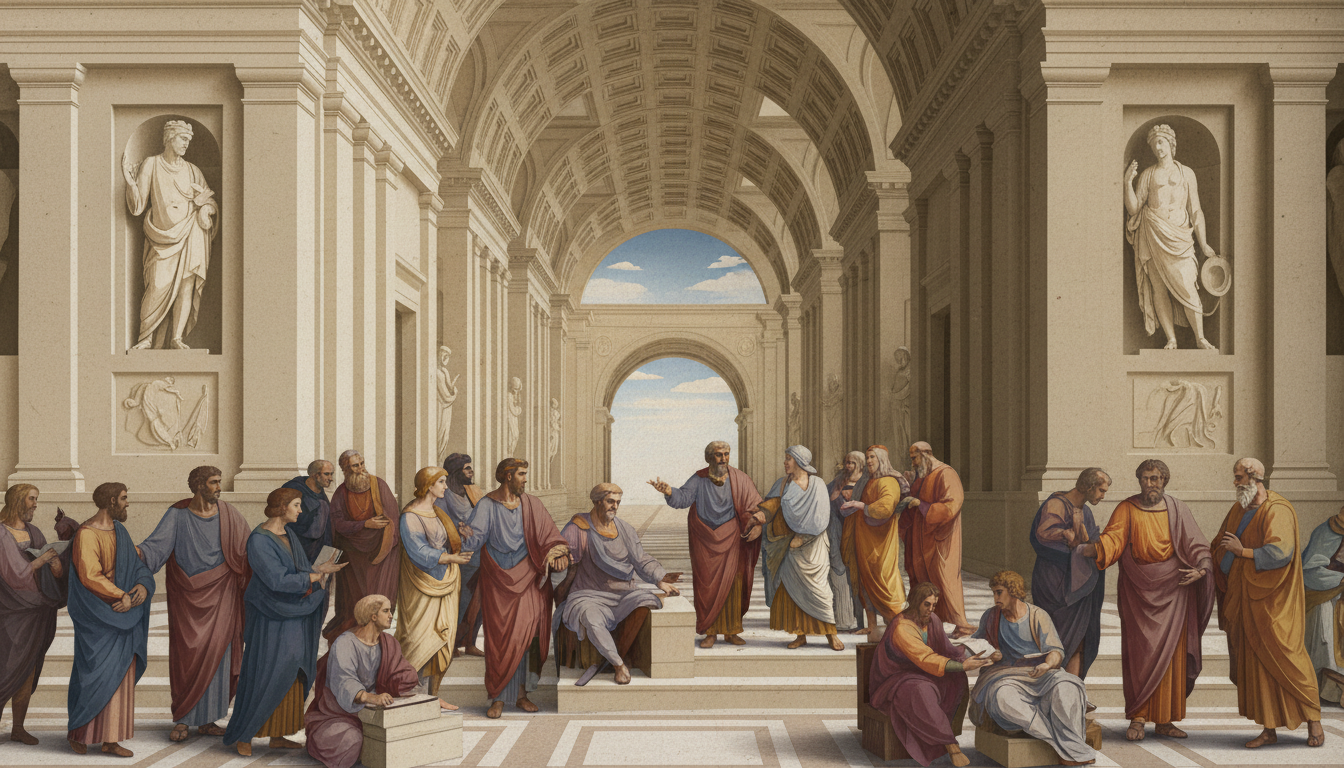
The School of Athens is one of the most celebrated frescoes of the High Renaissance. Painted by Raffaello Sanzio (commonly known as Raphael) between 1509 and 1511, it decorates the Stanza della Segnatura in the Apostolic Palace, Vatican City. The work gathers an imagined assembly of the great philosophers, mathematicians and scientists of antiquity and arranges them within a grand, classical architectural setting.
Historical context
Pope Julius II commissioned Raphael in 1508 to redecorate a suite of rooms in the Vatican now known as the Raphael Rooms. The Stanza della Segnatura was intended as the pope’s private study and library; its fresco program reflected a program of learning and authority. While the companion fresco Disputa (theology) celebrates spiritual truth, The School of Athens celebrates reason, philosophy and the rediscovered legacy of classical antiquity — a core idea of Renaissance humanism.
Where and when
Raphael executed the fresco between 1509 and 1511. It covers a large wall of the Stanza della Segnatura in the Vatican Palace (now part of the Vatican Museums). Painted in true fresco technique — pigments applied to wet plaster — the work was meant to be seen as part of a coherent intellectual program for the pope.
Who’s who in the fresco
The central pair of figures — Plato and Aristotle — form the compositional and philosophical heart of the fresco. Plato points upward, indicating his belief in transcendent forms; Aristotle gestures horizontally, emphasizing empirical observation and ethics. Raphael gives Plato the facial type of Leonardo da Vinci, a contemporary and intellectual reference, while Aristotle carries his Ethics.
- Plato (center left) — often identified by his gesture upward and by holding the Timaeus.
- Aristotle (center right) — shown with the Ethics and a downward gesture toward the earth.
- Socrates — recognized by his distinct features and engaged in debate on the left.
- Euclid/Archimedes — bending with a compass to demonstrate geometry (often linked to Bramante as the model).
- Pythagoras, Ptolemy and Zoroaster — figures who represent mathematics, astronomy and the interconnected sciences.
- Diogenes — sprawled on the steps, a witty, solitary figure of Cynic philosophy.
- Heraclitus — a melancholic brooding figure often thought to be Raphael’s likeness of Michelangelo.
- Raphael himself — painted as a young man looking out toward the viewer in the right-hand group.
Attributions for some figures are debated by scholars; Raphael blended historical portraiture, allegory and contemporary portraiture, so identifications sometimes rest on stylistic clues and tradition rather than documentary evidence.
Composition and style
Raphael’s mastery of composition and perspective is on full display. The architectural setting is a monumental basilica-like space filled with soaring arches and barrel vaults. A single vanishing point, located between Plato and Aristotle, organizes sight lines and draws the viewer’s eye to the philosophical dialogue at the center. Groups of figures form diagonals and clusters that balance motion and stillness across the scene.
Color and light play clear roles: cool blues and deep reds provide contrast; warm skin tones and glancing light animate the bodies. Raphael’s figures are naturalistic yet idealized — the clarity, rhythm and harmony of the scene express the Renaissance belief in order, proportion and the human capacity for understanding.
Meaning and interpretation
At one level the fresco is a visual catalog of ancient learning. More deeply, it stages a fundamental Renaissance argument about knowledge: the balance between contemplation and action, between metaphysical speculation and empirical inquiry. Placing philosophy (reason) in dialogue with theology in the room’s program suggests that the Church, under Julius II, could be a patron of learned culture — that faith and reason were complementary pillars of a well-ordered society.
Raphael’s inclusion of contemporary faces (Leonardo, Michelangelo, Bramante and himself) creates a bridge between antiquity and the artist’s present: the Renaissance as a revival of classical wisdom realized anew by modern minds.
Technique and the artist’s process
Raphael worked in the fresco medium, which requires swift and decisive application of pigment onto fresh lime plaster. He prepared detailed drawings and cartoons to transfer the composition to the wall — a workshop of assistants would have helped execute some areas under his supervision. Raphael’s control over draftsmanship, anatomy and gesture made it possible to animate dozens of figures while maintaining unity of scale and narrative.
Legacy and impact
The School of Athens became a touchstone for later artists and an emblem of the High Renaissance ideal. Its synthesis of classical subject matter, balanced composition and humanist philosophy influenced artists and theorists across Europe. The fresco has been reproduced in prints, copies and teaching materials for centuries and remains one of the most recognizable images of Western art.
Seeing the fresco today
The School of Athens remains in situ in the Stanza della Segnatura within the Vatican Museums. Viewing it in person reveals details that reproductions cannot fully convey: the scale of the architecture, the texture of the fresco surface and the subtlety of Raphael’s figural arrangement. If you visit, allow time to sit and follow the groupings across the scene — each cluster tells a small story within the larger dialogue.
Conclusion
More than a gathering of famous men, Raphael’s The School of Athens is a visual manifesto. It celebrates the recovery of ancient learning, the dignity of human reason, and the artist’s role as mediator between past and present. Painted in the first decades of the 16th century, it remains a defining image of the Renaissance — at once an intellectual portrait and a masterpiece of compositional brilliance.