Claude Monet: Light, Water, and the Birth of Impressionism and Legacy
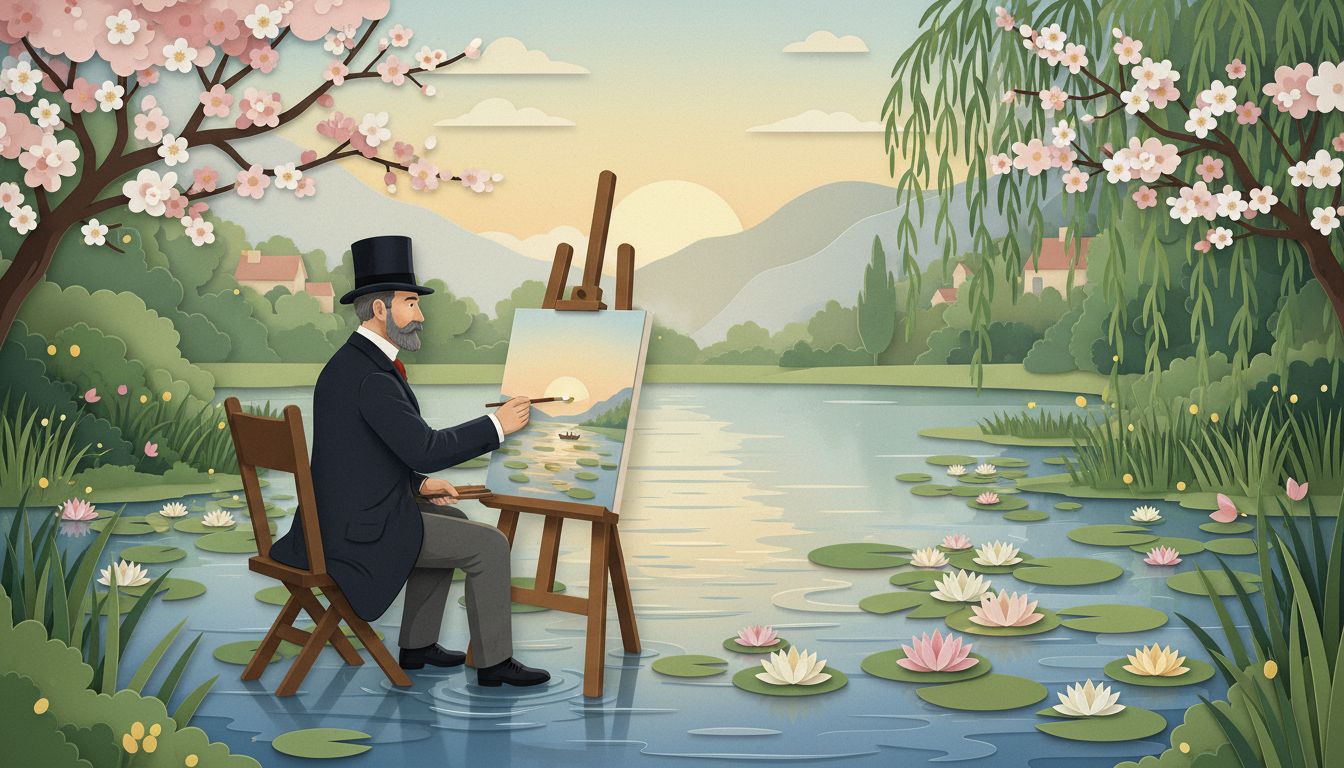
Claude Monet (November 14, 1840 – December 5, 1926) transformed the way artists see and paint the world. Through a lifelong obsession with light, atmosphere, and fleeting moments, Monet helped found Impressionism and created some of the most beloved images in modern art. This article traces his journey from childhood in Normandy to the water gardens of Giverny, highlighting the techniques, series, and personal struggles that shaped his work.
Early life and training
Monet was born in Paris on November 14, 1840, and spent much of his youth in Le Havre, Normandy. As a young man he sketched caricatures to support himself and soon studied under the landscape painter Eugène Boudin, who introduced him to painting outdoors (en plein air). In 1859 Monet moved to Paris to study art more formally, but he resisted academic conventions and later served in the military in Algeria for a short time before returning to the capital.
The Impressionist breakthrough
Monet's commitment to capturing light and momentary effects led him away from the Salon system. The pivotal work, Impression, soleil levant (Impression, Sunrise), painted in Le Havre in 1872, appeared in the first independent exhibition of the group in April 1874. A critic, Louis Leroy, coined the word "Impressionism" from Monet's title as a derisive label, but the artists embraced it. Key contemporaries and collaborators included Camille Pissarro, Pierre-Auguste Renoir, Alfred Sisley, Édouard Manet, and Edgar Degas.
Style, technique, and the series method
Monet challenged traditional studio practice by painting outdoors and working rapidly to record changing light. He favored loose, visible brushstrokes and a palette that emphasized pure color and optical mixing rather than blended tones. Later, Monet refined a method that would become a hallmark: painting the same subject repeatedly at different times and under varying conditions.
- Haystacks (Les Meules) (1890–1891) — exploring seasonal and diurnal shifts in color.
- Rouen Cathedral series (1892–1894) — capturing the façade at different hours and weather conditions.
- London series (late 1890s–early 1900s) — including Houses of Parliament and Waterloo Bridge, where fog and industrial atmosphere became subject matter.
These series show Monet's scientific curiosity about perception: he was less interested in a single perfected view than in the visual phenomenon itself.
Giverny: gardens as living canvas
In 1883 Monet moved to Giverny, a village on the Seine about 75 kilometers northwest of Paris. There he created two gardens that served as long-term, evolving subjects: the flower garden in front of his house and the now-famous water garden with its Japanese bridge, willow trees, and water-lily pond. From the 1890s until his death, Monet painted the pond and its reflections obsessively — the Water Lilies (French: Nymphéas) became an extended meditation on surface, depth, and the dissolution of perspective.
Later life: challenges and triumphs
Monet's later years were marked by both acclaim and difficulty. He achieved critical recognition and financial success, yet his eyesight deteriorated due to cataracts, altering his color perception. He underwent cataract surgery in the early 1920s and continued to work after the operation, producing monumental canvases intended for immersive display. In 1922 Monet completed a set of large panels that he later donated to the French state; these panels form the core of the Water Lilies galleries at the Musée de l'Orangerie in Paris, which opened after his death.
Key works to know
- Impression, Sunrise (1872) — Musée Marmottan Monet, Paris.
- Woman with a Parasol (1875) — National Gallery of Art, Washington, D.C.
- Haystacks series (1890–1891) — multiple museums.
- Rouen Cathedral series (1892–1894) — various collections.
- Water Lilies (c. 1896–1926) — seen across major museums; largest ensemble at Musée de l'Orangerie, Paris.
Legacy and influence
Monet died on December 5, 1926, in Giverny, leaving a radical legacy. His focus on perception and color paved the way for later modern movements—Post-Impressionists, Fauves, and even abstract painters drew from his experiments. More than technical innovation, Monet reshaped artistic goals: painting became a way to explore seeing rather than merely describing.
Monet's genius lies in his patience and curiosity: over decades he cultivated a garden, honed a method, and invited viewers to notice how light transforms everything. Standing before a Monet, whether an early harbor scene or a monumental Water Lilies panel, we are reminded that the world is always changing—and that art can make those changes visible.
Further reading and visiting
To understand Monet fully, visit Giverny (the house and gardens are open to the public) and view works in person when possible—the delicate effects of light are best appreciated on the canvas. Recommended institutions with major Monet holdings include the Musée d'Orsay and Musée Marmottan Monet in Paris, the National Gallery in London, and the National Gallery of Art in Washington, D.C.
Claude Monet remains one of modern art’s most luminous figures: his paintings continue to teach us how to see, one fleeting moment of light at a time.