Mona Lisa: History, Sfumato, and the World's Most Famous Painting
Leonardo's Mona Lisa (c. 1503–1519) — the world's most-visited painting. Guide to the sitter, sfumato technique, 1911 theft, and seeing it at the Louvre.
What Is the Mona Lisa?
The Mona Lisa is a half-length portrait by Leonardo da Vinci, painted in oil on a single sheet of Lombardy poplar wood between approximately 1503 and 1519. It measures 77 by 53 centimetres — smaller, in the room, than almost any visitor expects. The sitter, identified almost beyond reasonable doubt by a 2005 archival discovery, is Lisa Gherardini, the wife of a prosperous Florentine silk merchant named Francesco del Giocondo. The painting has been in the French royal and then national collection since around 1518, and has hung in the Musée du Louvre — apart from periods of theft and wartime evacuation — since 1797. It is the most visited painting in the world.
What the Mona Lisa actually depicts is a young Florentine woman, dressed simply, seated on a loggia balcony in front of an imaginary mountainous landscape, with her hands crossed at her wrist and her head turned to face the viewer. The pose was a portrait innovation in 1503; the slow, smoke-soft modelling of the flesh — Leonardo's signature sfumato — set a technical standard the European tradition would chase for the next three centuries. The painting's modern fame, however, rests on a tangle of art-historical, technical, and accidental factors that have less to do with the canvas itself than with what happened around it: the 1911 theft that turned it into a global news story, the 20th-century reproduction culture that made its face the most recognized in human history, and the institutional weight of the Louvre itself.
The Commission and the Sitter
The painting was probably commissioned in late 1503 by Francesco del Giocondo, a successful Florentine silk merchant, to celebrate either the birth of his second son Andrea (December 1502) or the recent purchase of a new house. Giorgio Vasari, writing in 1550, provides the only near-contemporary description of the commission. He reports that Leonardo took the work and laboured at it for four years without finishing it; that he employed musicians, singers, and jesters in the studio to keep the sitter's expression alive; and that the painting was 'still in the possession of King Francis I, at Fontainebleau,' when Vasari wrote — by then more than thirty years after Leonardo's death.
For most of the 19th and 20th centuries the identification of the sitter remained debated. Candidates floated in the literature included Isabella d'Este, Cecilia Gallerani, Pacifica Brandani, the Duchess of Francavilla, and a half dozen others. The argument was settled in 2005 by Armin Schlechter, a librarian at the University of Heidelberg. Working through the library's collection of incunabula, Schlechter found, in the margin of a 1477 edition of Cicero's letters, a handwritten note dated October 1503 by Agostino Vespucci, a Florentine official and acquaintance of Leonardo's. The note reports that Leonardo is at work on three paintings at that moment — one of them 'the head of Lisa del Giocondo.' That single sentence, contemporary with the commission and from a witness who knew Leonardo personally, ended the centuries of speculation. The sitter is Lisa Gherardini.
Lisa Gherardini was twenty-four when the painting was begun. She had been married to Francesco del Giocondo since 1495, when she was fifteen and he was about thirty. Five surviving children are documented. She outlived her husband, who died of plague in 1538, and was probably buried at the convent of Sant'Orsola in Florence on her own death in July 1542 — though forensic excavations in 2011–2015 at Sant'Orsola, hoping to recover her remains, were inconclusive.
Leonardo never delivered the painting. He left Florence for Milan in 1508, taking the unfinished panel with him; carried it onward to Rome around 1513; and finally took it across the Alps to France in 1516 when he entered the service of King Francis I. He continued to work on it until shortly before his death in 1519. By 1518 the painting was already in the French royal collection, sold to or acquired by Francis I from Leonardo's heirs — most likely directly from Leonardo himself in the last year of his life. The Giocondo family in Florence never owned it.
Composition and Pose
The composition is built on the simplest possible underlying geometry — an equilateral triangle, the apex at the sitter's head, the base running through her crossed wrists. Within that pyramidal stability Leonardo introduces a series of carefully calibrated departures from quattrocento portrait convention. The sitter is shown half-length rather than as a bust; she is turned three-quarters to the picture plane rather than in strict profile; her gaze meets the viewer rather than averting modestly; she sits on a high loggia open to a landscape behind her, framed by the bases of two columns. The result is the foundational template for European portraiture from Raphael's Maddalena Doni (1506) onward.
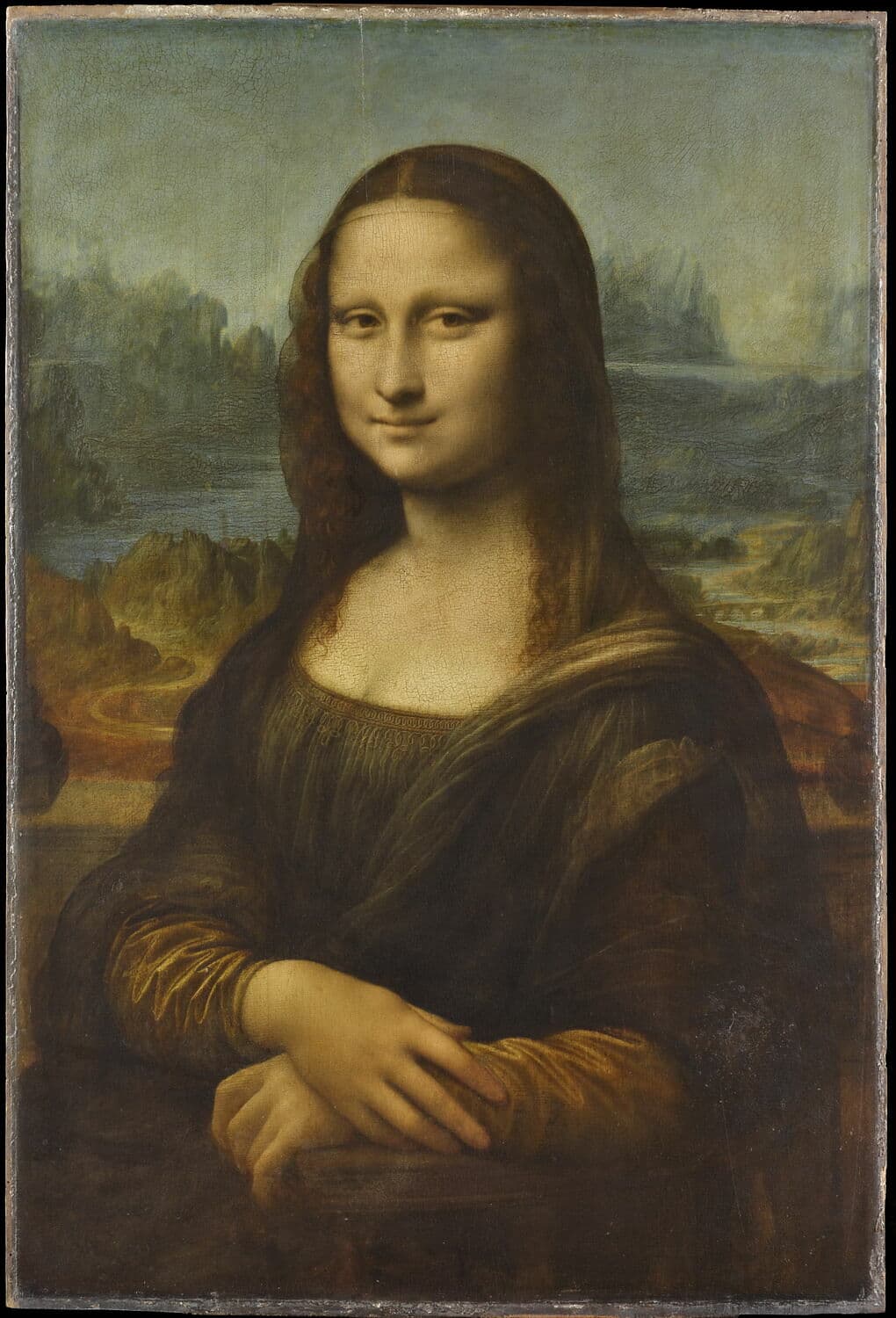
- Eyes — Sfumato is most pronounced at the inner corners of the eyes and around the upper eyelids. The eye-line of the sitter meets the viewer in any position in the room — a property of the painted gaze first systematically discussed by 19th-century perceptual psychology.
- Mouth — The corners of the mouth are built of an estimated twenty to thirty translucent glazes, each shifting the local tone by a fraction of a percent. The smile appears most strongly in peripheral vision, weakest when looked at directly.
- Hands — The crossed hands at the wrist are the calmest and most carefully painted hands in Western portraiture. They establish the foreground plane of the pyramidal composition and give the entire painting its sense of restraint.
- Balustrade columns — Two column bases frame the figure on the loggia. The painting was likely cut down by a few centimetres on the left and right sides at some point before the 17th century — early copies, including a workshop replica at the Prado, show the columns more fully visible.
- Aerial-perspective horizon — The mountains in the upper right recede in cool blue atmospheric perspective, theoretically rigorous and far in advance of any earlier European painting in the systematic use of the effect.
- Divided horizon — The horizon line on the left of the sitter's head is markedly lower than the horizon on the right. The asymmetry produces a faint instability in the spatial reading of the background — one of the painting's strangest formal features.
Sfumato: The Smoke Around the Smile
Sfumato — from the Italian sfumare, to dissipate like smoke — is the technique Leonardo describes in the Trattato della pittura as the dissolution of contour into atmosphere. Forms should not be outlined; they should emerge from shadow by gradations so fine that the eye cannot identify a beginning or an end. The corners of the Mona Lisa's mouth, the inner edges of her eyes, and the shadow beneath her chin are the canonical examples of the technique. There is no line anywhere on the painting.
Scientific examination has shown how the effect was produced. In 2007 the French engineer Pascal Cotte — using a custom-built multispectral camera that captured the painting in thirteen wavelengths from ultraviolet through visible light to infrared — published an analysis showing that the flesh tones of the face are built from at least thirty translucent glazes, each only a few micrometres thick, laid down one over the other with brushes of one or two hairs. There are no visible brushstrokes anywhere on the face because none of the individual strokes is thick enough to leave a mark. The Centre de recherche et de restauration des musées de France (C2RMF) has confirmed and extended these findings using X-ray fluorescence, infrared reflectography, and synchrotron analysis. The pigments are conventional for the period — lead white, vermilion, lead-tin yellow, azurite, ultramarine, earth umbers — but the technique is sui generis.
The smile itself — the most famous expression in Western art — emerges from this technique rather than from any specific feature. The corners of the mouth are softer than the rest of the face. The transition between the upper lip and the cheek is built of perhaps twenty glazes, each shifting the local value by a fraction of a percent. The eye reads the smile differently depending on where it is focused: looking directly at the mouth, the smile fades; looking at the eyes, the smile appears more strongly in peripheral vision. This is a property of the visual system rather than a trick of the painting — the difference in resolution between foveal and peripheral vision — but it is one Leonardo seems to have understood and exploited, and one that has not been replicated in any other portrait.
The Imaginary Landscape
Behind the sitter, the loggia opens onto a landscape that does not exist anywhere on Earth. To the left, a winding road descends into a valley; to the right, what appears to be a stone bridge crosses a river or estuary; in the distance, jagged mountains recede in cool blue atmospheric perspective into a hazy sky. The two halves of the landscape do not align with each other: the horizon on the left of the head sits noticeably lower than the horizon on the right, an asymmetry that contributes to the painting's strange, dreamlike instability. Several scholars have argued that the bridge resembles the Buontalenti-style Ponte Buriano over the Arno east of Florence, and that the road may follow the Valdichiana valley Leonardo had surveyed for Cesare Borgia in 1502–03. The reading is plausible but unprovable: the landscape is best understood as imagined, a topography assembled from Leonardo's notebooks rather than copied from any single view.
The use of aerial perspective — the systematic paling and blueing of distant elements to suggest depth through atmosphere — is more theoretically rigorous than in any earlier European painting. Leonardo had been studying the effect since the 1480s; the Mona Lisa is its purest application. The mountains in the upper right read as a separate optical event from the head and shoulders in the foreground, as though seen through a different lens. The painting becomes a layered atmospheric stage rather than a flat single-plane portrait.
From Florence to the Louvre
The painting's history of ownership is unusually well documented for a 16th-century work. It has spent its entire life in royal and then national collections — almost five centuries with effectively four owners. The major events are summarised in the timeline below.
- c. 1503–1519Painted by Leonardo da Vinci
Begun in Florence at the commission of Francesco del Giocondo and worked on intermittently by Leonardo across Florence, Milan, Rome, and France for the remaining sixteen years of his life. Never delivered to the Giocondo family.
- c. 1518Acquired by King Francis I of France
Purchased from Leonardo (or from his heir Salaì shortly after Leonardo's death) by Francis I for 4,000 écus and brought into the French royal collection. Hung at the royal château of Fontainebleau in a special bathhouse Francis built to display the king's most important paintings.
- 1683Transferred to Versailles
Moved by Louis XIV to the new royal residence at Versailles and hung at first in the Cabinet des Tableaux. Spent the rest of the ancien régime in the king's private apartments rather than on public display.
- 1797Enters the Louvre
Transferred to the newly opened Musée Central des Arts (the future Louvre) following the French Revolution and the conversion of the royal palace into a public museum.
- 1800–1804In Napoleon's bedroom
Removed from the Louvre by Napoleon Bonaparte and hung in his bedroom at the Tuileries Palace. Returned to the Louvre on Napoleon's coronation in 1804.
- 21 August 1911Stolen by Vincenzo Peruggia
Removed from its hooks in the Salon Carré on the Monday cleaning day by the Italian carpenter Vincenzo Peruggia. The theft was not noticed for twenty-six hours and the painting remained hidden in Peruggia's Paris room for twenty-eight months.
- December 1913Recovered in Florence
Peruggia wrote to the Florentine dealer Alfredo Geri offering to sell the painting to Italy. He was arrested at a Florence hotel after the painting was authenticated by Giovanni Poggi of the Uffizi. The Mona Lisa toured Italy for several weeks before being returned to Paris.
- 4 January 1914Returned to the Louvre
Restored to public display in the Salon Carré. Newspaper coverage of the theft and recovery produced what is now generally regarded as the painting's modern global fame.
- 1939–1945Wartime evacuation
Evacuated from Paris in the days before the German occupation in 1940 and hidden in a series of châteaux in the unoccupied zone — first at Chambord, then at Louvigny, Loc-Dieu, and Montauban — by curators acting on the orders of Jacques Jaujard. Returned to the Louvre in 1945.
- 1974Touring exhibitions
Loaned, exceptionally and for the last time, to Tokyo and Moscow. The painting has not left the Louvre since.
- 2005Salle des États reopens
After a six-year renovation of the Denon Wing, the Mona Lisa was installed on a free-standing wall in the centre of the redesigned Salle des États behind bulletproof glass. The wall opposite holds Veronese's Wedding at Cana, by far the largest painting in the museum.
- 2024Timed-ticket viewing introduced
Following years of complaint about overcrowding, the Louvre introduced compulsory online timed-ticket reservation and announced plans to give the painting its own dedicated room in the long-term redevelopment of the museum.
The 1911 Theft and Global Fame
On the morning of Monday, 21 August 1911, the Louvre was closed to the public for the weekly cleaning day. Vincenzo Peruggia, a thirty-year-old Italian carpenter who had been employed by the museum the previous year to build the glass cases protecting its most important paintings, entered the Salon Carré in workman's clothes, lifted the Mona Lisa off its four iron hooks, walked into a service staircase, took the painting out of its frame, hid the panel under his smock, and walked out of the museum through a door whose lock was missing. The painting was not noticed missing for twenty-six hours. When the theft was finally reported, the Paris prefect of police closed the museum for a week, interrogated more than a hundred employees, and produced no result.
The investigation generated a level of newspaper coverage no painting had ever received. Photographs of the empty wall in the Salon Carré ran on the front pages of every European and American daily. Within a week the Mona Lisa was more famous as an absent object than it had ever been as a present one. The poet Guillaume Apollinaire and the painter Pablo Picasso were briefly detained as suspects — both had previously bought stolen Iberian sculptures from a Louvre attendant — but were released. Peruggia hid the panel in a false-bottomed trunk in his rented room near the Gare de l'Est for twenty-eight months.
On 10 December 1913 Peruggia wrote to the Florentine dealer Alfredo Geri offering to sell the painting back to Italy. He claimed to be motivated by patriotism — wishing to return a stolen national treasure to its true home — though there is good evidence he had also been negotiating with several other buyers. Geri arranged a meeting with the director of the Uffizi, Giovanni Poggi; the two met Peruggia at a hotel in Florence; the painting was lifted out of the trunk and authenticated; Peruggia was arrested. He served seven months for the theft and lived out the rest of his life quietly in northern Italy. The Mona Lisa, after a brief triumphal tour of Italian cities, was returned to the Louvre on 4 January 1914.
The theft is the single most important event in the painting's modern history. Before 1911 the Mona Lisa was admired by art historians as a remarkable example of Leonardo's late style, but it was not yet the global icon it would become. The two years of front-page coverage during the theft and recovery — at exactly the moment that mass-circulation illustrated newspapers and postcards were achieving global reach — created the public for whom the painting would matter. By the 1920s its face was already the most reproduced in the world. The technique, the smile, and the sitter are what art historians study; the theft is what made the painting famous.
The Mona Lisa in Popular Culture
The Mona Lisa has been parodied, copied, defaced, mass-produced, and quoted in almost every visual medium of the 20th and 21st centuries. The list below is a small selection of the most-cited appearances; a complete inventory would run to thousands of items. The painting's status as the canonical image of Western art makes it a natural target for any artwork that wishes to comment on tradition, museums, celebrity, or the visual culture of reproduction itself.
- Marcel Duchamp, L.H.O.O.Q. (1919) — a small postcard reproduction of the painting on which Duchamp drew a moustache and goatee and added a five-letter title that, read aloud in French, is a vulgar pun. The most-cited Dada gesture in 20th-century art.
- Salvador Dalí, Self-Portrait as Mona Lisa (1954) — Dalí's face superimposed on the Mona Lisa's body, his moustache borrowed from Duchamp's earlier intervention.
- Nat King Cole, 'Mona Lisa' (1950) — pop standard by Ray Evans and Jay Livingston that became the best-selling song of 1950 and the canonical English-language reference to the painting.
- Andy Warhol, Thirty Are Better Than One (1963) — silkscreened grid of thirty Mona Lisas, the painting's image multiplied by the technique of mass reproduction Warhol used for the Marilyn Monroe and Campbell's Soup canvases of the same year.
- Dan Brown, The Da Vinci Code (2003) — best-selling novel built around a fictional iconographic reading of the painting; sold more than 80 million copies worldwide and produced a 2006 Hollywood film starring Tom Hanks.
- Banksy, Mona Lisa Bazooka (c. 2000) — stencil work showing the Mona Lisa carrying a rocket launcher; one of several Banksy interventions over the years.
- 2009 paint mug — a tourist threw an empty terracotta mug at the painting; the glass was undamaged. The painting was unharmed but the incident drew renewed attention to security.
- 2022 cake-smearing attack — a young man in a wig and a wheelchair smeared cream from a hidden cake onto the protective glass before being removed by gallery staff. The painting was again undamaged; the incident was an environmentalist protest.
- 2024 soup attack — two Riposte Alimentaire activists threw pumpkin soup at the painting in support of a food sovereignty campaign. Again the glass took the impact; the painting was unharmed.
- Countless advertising, fashion, cartoon, and meme appearances — from the Marx Brothers and Looney Tunes to TikTok filters and AI-generated remixes. The face is the most reproduced human image in the world after, possibly, that of Jesus Christ.
Seeing the Painting Today
The Mona Lisa hangs in the Salle des États of the Louvre — a large purpose-built gallery in the Denon Wing — behind a sheet of bullet-resistant glass on a free-standing wall, with a one-way visitor flow controlled by stanchions. The room receives roughly 30,000 visitors a day in peak season, almost all of them there for the single painting on the far wall. The other major works in the room — Veronese's vast Wedding at Cana, opposite the Mona Lisa, and a strong group of Italian 16th-century paintings — are routinely overlooked.
Practical advice for visitors: timed-entry tickets are now required and must be reserved online in advance through the Louvre's website. Arrive at the museum's opening on a weekday rather than a weekend. The painting is at the far end of a single straight corridor from the entry — turn right from the pyramid into the Denon Wing, climb the Daru staircase past the Winged Victory of Samothrace, and walk straight ahead. The painting is much smaller than its reputation suggests; viewing it from the back of the rope barrier, perhaps three metres away, is the closest most visitors get. The bullet-proof glass and the angle of the room lighting mean that the colour and the surface detail are difficult to read in person — high-resolution online reproductions, such as the Louvre's own gigapixel image, are often more informative for studying the technique.
Read next
- ArtistsLeonardo da Vinci: Life, Paintings, and the Universal MindLeonardo da Vinci (1452–1519): Italian Renaissance painter, scientist, and engineer whose Mona Lisa and Last Supper defined Western art's idea of genius.
- ArtistsVincent van Gogh: Life, Paintings, and the Birth of Modern ArtVincent van Gogh (1853–1890) was a Dutch Post-Impressionist painter whose vivid color and expressive brushwork shaped 20th-century art.
- MovementsWhat Is Impressionism? Origins, Artists, and Influence on Modern ArtImpressionism is a 19th-century French art movement defined by visible brushwork, open-air painting, and the depiction of fleeting light and everyday life.
Frequently asked questions
Who is the Mona Lisa?
The sitter is Lisa Gherardini, a young Florentine woman married to the silk merchant Francesco del Giocondo. The identification — settled in 2005 by a marginal note in Heidelberg University Library written in October 1503 by the Florentine official Agostino Vespucci — is now essentially uncontested. She was twenty-four when the painting was begun and lived another four decades; she was probably buried at the convent of Sant'Orsola in Florence in 1542.
Why does the Mona Lisa have no eyebrows?
Two reasons combine. First, fashionable Florentine women of the early 16th century plucked their eyebrows and hairlines very high — Lisa Gherardini herself may have done so. Second, infrared and ultraviolet imaging by the engineer Pascal Cotte have shown that Leonardo did paint extremely fine eyebrows in his final layers, but that they have worn away over the centuries through over-cleaning and the action of the varnish. The painting in its present state is a fragment of what Leonardo finished.
What is sfumato?
Sfumato — from the Italian sfumare, to dissipate like smoke — is Leonardo's technique of dissolving contours into atmosphere by means of dozens of translucent oil glazes laid down one over the other. The transitions between light and shadow on the Mona Lisa's face are produced by an estimated thirty or more glazes, each only a few micrometres thick, applied with brushes of one or two hairs. There are no visible brushstrokes anywhere on the face. The effect is the foundation of every subsequent attempt to render flesh in oil paint.
Why is the Mona Lisa so famous?
The painting has been considered a masterpiece by art historians since the 16th century, but its modern global fame is largely the result of its 1911 theft from the Louvre by the Italian carpenter Vincenzo Peruggia. The two-year investigation and recovery received unprecedented international newspaper coverage at exactly the moment that mass-circulation illustrated newspapers and postcards were achieving global reach. The painting's face became the most reproduced human image in the world during the 1920s and has remained so. The technique, the smile, and the sitter explain why the painting matters; the theft is what made it famous.
Has the Mona Lisa ever been damaged?
Several times. In 1956 a Bolivian visitor named Ugo Ungaza Villegas threw a rock at the painting, chipping a pigment fragment near the left elbow that was later restored; the same year a separate attacker threw sulphuric acid. After these incidents the painting was protected by glass. In 2009 a Russian tourist threw a terracotta mug at the glass; in 2022 a young man in a wig smeared cream from a hidden cake on the protective barrier; in 2024 a pair of food-sovereignty activists threw pumpkin soup. The painting itself has not been seriously damaged since the 1956 acid attack.
How big is the Mona Lisa?
77 by 53 centimetres (30 by 21 inches). It is smaller than almost any visitor expects. The painting is half-length, painted on a single sheet of Lombardy poplar wood approximately one centimetre thick, and was likely cut down by a few centimetres on the left and right sides at some point before the 17th century — early copies, including a workshop replica at the Museo del Prado in Madrid, show the columns of the loggia balustrade more fully visible than they are now.
Where can I see the Mona Lisa?
The painting hangs in the Salle des États of the Musée du Louvre in Paris — the Denon Wing, Room 711, on the first floor. Timed-entry tickets are required and must be reserved in advance through louvre.fr. Best viewing window: arrive at opening on a weekday. The painting receives roughly 30,000 visitors a day in peak season and has not been on loan outside the Louvre since 1974.
Is the Mona Lisa really smiling?
The corners of the mouth are slightly upturned but the expression is famously ambiguous. The ambiguity is a deliberate consequence of the painting's technique: the area around the mouth is built of about twenty to thirty translucent glazes that produce a transition between expression states rather than a single fixed expression. The visual system reads the smile more strongly in peripheral vision than when looking directly at the mouth — a property of the difference in resolution between the centre and the edges of the human visual field. The effect has not been replicated in any other portrait.
Sources
- Mona Lisa | Musée du Louvre(Editorial reference)
- Mona Lisa | Smarthistory(Editorial reference)
- Mona Lisa, Leonardo da Vinci — Encyclopædia Britannica(Editorial reference)
- Mona Lisa — Wikipedia(CC BY-SA 3.0)
- Pascal Cotte, Lumière on the Mona Lisa (Vinci Editions, 2015)(Editorial reference)
- Heidelberg University Library marginalia on the Mona Lisa sitter identification (Vespucci 1503)(Editorial reference)